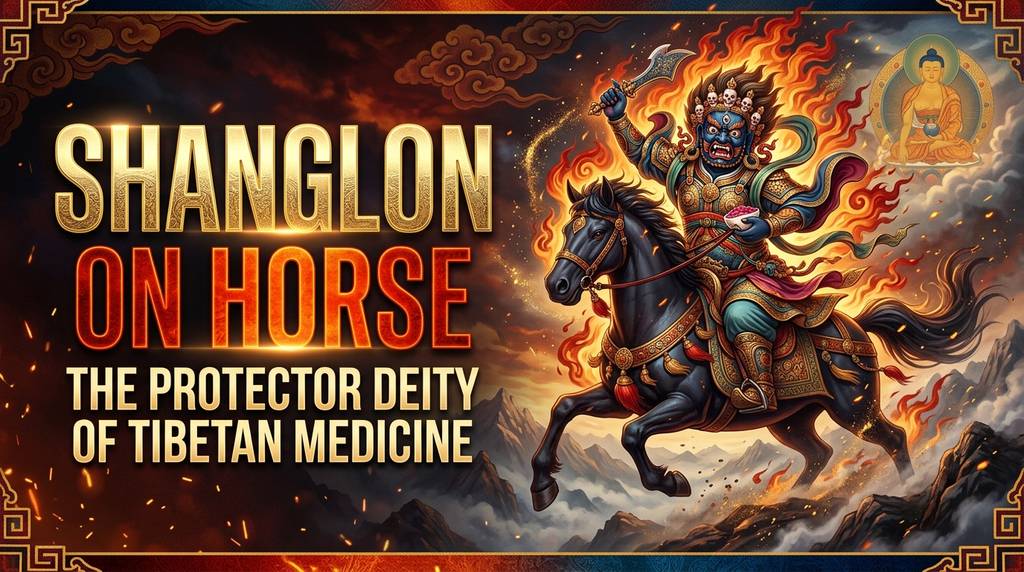
Among Tibetan Buddhism’s protector figures, Shanglon Dorje Dudul on horseback stands out for its sense of motion. Unlike his seated forms, this manifestation shows him mounted and in dynamic movement, surrounded by a retinue, a wrathful, Mahakala-like deity tied to the Yuthok Nyingthig, a cycle of teachings connected with Tibetan medicine.
Who Is Shanglon Dorje Dudul?
Also known as Sangwai Gonpo (“Minister, Secret Lord, Great Black One”), Shanglon is classified among the wrathful Mahakala-type protectors, fierce in appearance, but meant to ward off obstacles rather than cause harm. He’s connected to the Yuthok Nyingthig, a tantric cycle tied to Yuthok Yonten Gonpo, the physician credited with compiling the Four Medical Tantras that form the foundation of Tibetan medicine.
He appears in two main forms: a seated wrathful figure (in Outer, Inner, and Secret Accomplishment variations) and the horse-riding form specific to the Yuthok Nyingthig cycle.
Horse-Riding vs. Seated Shanglon
| Horse-Riding Shanglon | Seated Shanglon |
|---|---|
| Tied to the Yuthok Nyingthig | Includes Outer, Inner, and Secret Accomplishment forms |
| Rides a horse | Generally depicted seated |
| Accompanied by eight deities | Retinue varies by form |
| Dynamic composition | More stationary presentation |
An Eight-Deity Retinue
This form is traditionally shown with eight attendant deities, including Red Hayagriva, Buddha Shakyamuni, Amitayus, the Root Guru Medicine Buddha, Guru Padmasambhava, and Guru Yuthok, turning the image into a full assembly of protective forces rather than a lone guardian. Together they express the Vajrayana idea that protection is a collective, interconnected activity.
Reading the Symbolism
Every element carries meaning: the horse represents readiness and movement, the wrathful expression conveys uncompromising resolve, the chopper symbolizes cutting away obstacles, the skull cup represents tantric transformation, and the surrounding flames express the intensity of awakened activity. In sculpture, this composition is especially demanding; the horse must support the rider both visually and structurally, while flowing garments, weapons, and flames all preserve a sense of motion.
How to Identify Him
Since several protectors appear on horseback, identification depends on the whole composition, not the horse alone:
- A wrathful, Mahakala-like appearance
- The horse as mount
- Connection to the Yuthok Nyingthig lineage
- Association with Tibetan medicine (Medicine Buddha, medical mandalas)
- The presence of his protective retinue
Why He Matters
Shanglon sits at the meeting point of Buddhist spirituality and Tibetan medicine, a reminder that preserving a healing tradition takes more than medical knowledge alone; it requires safeguarding the teachers, texts, and practices that keep it alive. His horseback form gives that responsibility a vivid visual language: readiness, motion, and forceful, enlightened protection.