


Siddhartha Gautama was born a prince in the 6th century BCE near Lumbini, in present-day Nepal. His father sheltered him from suffering inside a palace of luxury. Outside the palace walls, he met an old man, a sick man, a corpse, and a wandering ascetic, and these Four Sights broke his belief that youth, health, and pleasure last. At 29 he left his home, wife, and newborn son to search for truth.
He first tried extreme fasting and self-denial, then found that harsh asceticism led no closer to enlightenment than luxury had. This led him to the Middle Way, a balanced path between indulgence and deprivation. After 49 days of meditation under the Bodhi tree in Bodh Gaya, he awakened and became the Buddha. He spent the next 45 years teaching across northern India, centering his message on the Four Noble Truths and the Eightfold Path. Most Buddhist schools revere him as a teacher and an example of what any person can achieve, not as a god.
From Symbols to Statues
For the first several centuries after his passing, the Buddha was not shown in human form. Artists used symbols such as an empty throne, a Bodhi tree, footprints, or a Dharma wheel, likely out of reluctance to reduce an enlightened being to a physical likeness. The first human-form statues appeared around the 1st century CE in two places at once. In Gandhara, Greco-Roman artistic influence merged with Buddhist themes, and in Mathura, artists developed a distinctly Indian style.
As Buddhism spread along the Silk Road, each culture reshaped the image. Thai Buddhas tend to be slim and elongated, Japanese ones serene and rounded, Tibetan ones richly ornamented, and Sri Lankan and Southeast Asian ones simpler and quieter. Some features stay constant everywhere: the urna between the eyebrows, which stands for wisdom, the elongated earlobes recalling his princely past, the half-closed gaze, and the use of specific hand gestures called mudras.
Popular Forms and What They Mean
- Reclining Buddha: He lies on his right side with his head resting on his hand, showing his passing into nirvana. It stands for peace, release, and freedom from suffering.
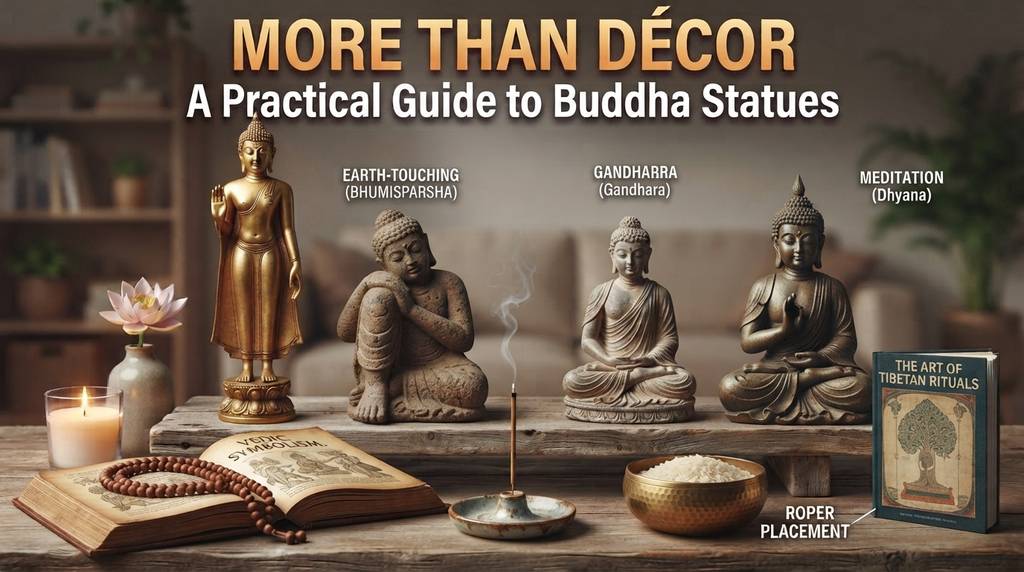
- Earth-Touching Buddha: His right hand reaches toward the ground while his left rests in his lap. He is calling the earth to witness his victory over Mara, which makes this posture a symbol of determination.
- Standing Buddha: A raised palm in the Abhaya mudra means freedom from fear, and a lowered open hand in the Varada mudra means granting wishes. Some standing figures hold the hem of the robe to suggest teaching in motion.
- Meditating Buddha: Both hands rest in the lap with thumbs touching, the most familiar image, standing for deep concentration and wisdom found through stillness.
- Fasting Buddha: His ribs and bones show through, recalling the extreme austerities he practiced before finding the Middle Way. It represents perseverance and the will to endure hardship.
- Infant Buddha: Newborn Siddhartha takes his first seven steps, one hand pointing up and the other down. It symbolizes purity and new beginnings, and it is a popular gift for new parents.
Materials and Their Meanings
Metal is the most common medium because it is durable and holds fine detail. Copper, common in Nepal and Tibet, is associated with purification and grounding, and it develops a natural patina with age. Brass is affordable and carves well, which suits both handmade and mass-produced pieces. Gold stands for the highest purity and enlightenment, so it is usually reserved for temple images and valuable collectibles. Silver, often used for small, detailed pieces, suggests a calm and clear mind. Traditional five-metal alloys, used in South Asian temple idols for centuries, are believed to combine the symbolic value of each metal.
Wood adds warmth and a natural feel. Teak is strong and resists rot and insects, so it suits large statues meant to last generations. Rosewood has a dark, rich grain and is often used for small hand-carved pieces. Sandalwood is considered the finest, prized for its fine carving quality and its fragrance, which ties into ritual use. Wooden statues should be kept away from moisture and direct sunlight. Clay is one of the oldest materials. It is inexpensive and easy to hand-mold, and it is often used in temples, festivals, and eco-friendly idols for water immersion. It chips easily, so it needs a dry, low-traffic spot.
Choosing the Right Statue
The best choice usually follows your intention. A meditating Buddha in a soft material like wood or resin suits a desk or bedside table for calm and stress relief. The Earth-Touching posture is a good companion through difficult periods, when courage matters. A reclining Buddha can gently accompany grief or a major life transition, and an infant Buddha marks a fresh start. For an entrance or garden, a large stone or bronze figure makes a lasting statement, while a gold-plated or five-metal statue brings reverence to a dedicated devotional space. In the end, the right statue is the one whose expression, posture, or material speaks to you.
Why Keep a Buddha Statue?
People keep Buddha statues for spiritual and aesthetic reasons alike. The calm, half-smiling expression is a visual cue to pause and breathe, and a statue on a desk, shelf, or entryway serves as a daily reminder of mindfulness. It also works as a focal point for meditation. Many traditions, including Vastu Shastra, believe a well-placed statue brings harmony, abundance, and protection into a home. Others value it as a design element that suits everything from bohemian to modern zen, as a thoughtful housewarming or wedding gift, or as a link to cultural heritage and Asian art and philosophy.
Where to Place Your Statue
Placement is treated with care in many traditions. The statue should sit at eye level or higher, never on the floor, as a sign of respect. Bathrooms are avoided because they are considered impure. The living room, especially near the entrance, is a favored spot for welcoming grounded energy. A prayer altar works best facing east, for new beginnings, or north, which is considered auspicious. In a garden or courtyard, stone or metal suits the outdoors, especially near water, which stands for tranquility and flow. A small teaching Buddha on a study or office desk helps you stay focused. In the bedroom, avoid placing it facing the bed or at its foot.
As a rule of thumb, heavy materials like stone, large bronze, and clay belong outdoors or on a pedestal, while lighter wood, small metal castings, and resin suit indoor shelves, altars, and tabletops.
Caring for Your Statue
Dust metal statues with a soft, dry cloth. Brass and copper can occasionally be cleaned with a metal-safe cleaner, but harsh products can strip the natural patina. Keep wooden statues away from direct sunlight and high humidity to prevent fading, cracking, and warping, and apply natural wood oil now and then to maintain the finish. Handle clay statues gently and store them somewhere dry and out of the way. Many traditions also ask that the statue be treated as sacred, which means using a dedicated cloth, never stacking objects on or around it, and keeping its surroundings clean.
Famous Buddha Statues Around the World
- Great Buddha of Kamakura, Japan: A 13th-century seated bronze that survived earthquakes, typhoons, and a tsunami that destroyed its temple hall.
- Leshan Giant Buddha, China: The world’s tallest stone Buddha at over 70 meters, begun in 713 CE and taking about 90 years to complete.
- Reclining Buddha at Wat Pho, Thailand: A 46-meter gold-plated figure in Bangkok, with mother-of-pearl inlay on the soles of its feet.
- Bamiyan Buddhas, Afghanistan: Giant figures carved into a sandstone cliff about 1,500 years ago and destroyed by the Taliban in 2001. They remain historically and culturally important.
- Mahabodhi Temple, Bodh Gaya, India: The site where the Buddha is believed to have attained enlightenment.
- Ushiku Daibutsu, Japan: One of the tallest statues in the world at around 120 meters.
- Monywa Buddha, Myanmar: A standing Buddha of about 116 meters, one of the tallest anywhere.
- Sarnath, India: The site of the Buddha’s first sermon, filled with ancient stupas and statues in the Dharmachakra mudra.
- Tian Tan Buddha, Hong Kong: A bronze seated Buddha completed in 1993 on Lantau Island and now a major pilgrimage and tourist site.
Conclusion
The Buddha statue has traveled a long way, from early symbols like the empty throne and Bodhi tree to giant bronze and stone monuments visited by millions. Every culture has reshaped it, yet its central message holds: compassion and self-understanding are open to anyone willing to look for them. Choosing a statue is a personal decision. It can rest on the posture that speaks to you, the material that suits your space, and a thoughtful spot to place it. Placed with care, it becomes a small, steady reminder to slow down and live with more peace and clarity.


