Composed around 483 BCE and preserved in the Dīgha Nikāya, the Mahāparinibbāna Sutta, the Great Discourse on the Total Unbinding, is at once biography, ethical instruction, and philosophical testament. It traces the Buddha’s final journey from Rājagaha to Kusinārā during his eightieth year, interweaving his physical decline with some of his most essential teachings. For Buddhist practitioners, it functions less as a historical record than as a spiritual map: guidance for navigating loss, maintaining practice, and preserving the integrity of a community when its guiding presence is no longer there.
The Final Itinerary
The sutta unfolds across eight chapters, following the Buddha’s deliberate passage through the towns and communities of ancient northeastern India. Each stopping point is the occasion for a specific teaching so that the journey itself becomes a structured act of transmission, the Enlightened One dispensing what is most necessary at each stage of a final pilgrimage.
Rajagaha
The narrative opens here, where King Ajātasattu seeks counsel. The Buddha outlines the seven conditions for communal welfare, a governance teaching that frames everything that follows.
Vesali
The Buddha addresses monastic dispute resolution and delivers teachings on the dangers of communal division. He also formally announces his approaching death to Ānanda.
Bhoganagara
A warning is issued against false teachers who claim the Buddha’s authority without genuine grounding in the Dhamma and Vinaya.
Pava
The Buddha shares his final meal offered by Cunda the blacksmith, which leads to the illness that precedes his death. He explicitly praises Cunda’s gift, absolving him of responsibility.
Kusinara
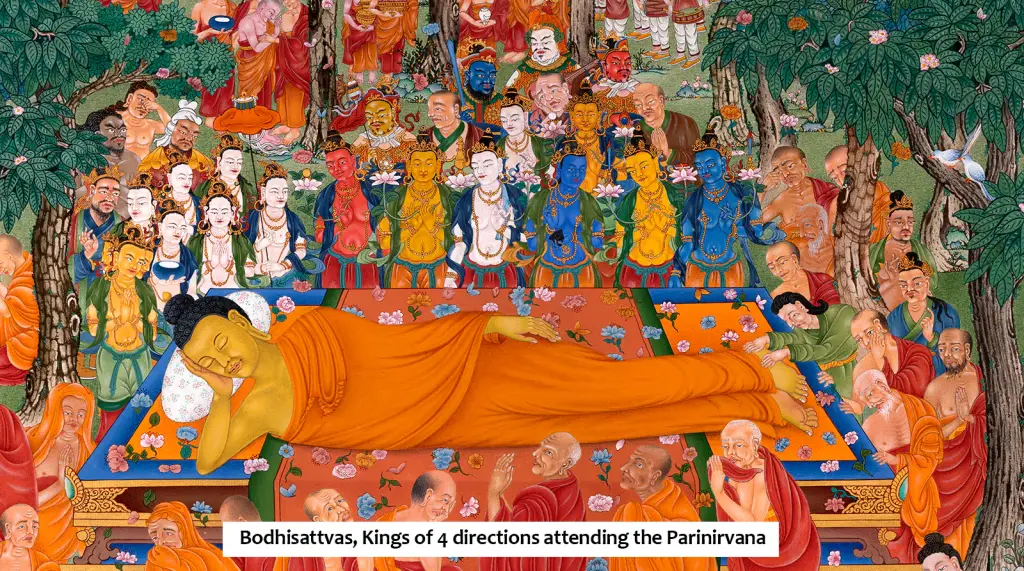
Between twin sal trees in full bloom, the Buddha enters parinibbana, surrounded by monks, laypeople, and according to tradition, celestial beings. His final words are addressed to the assembled community.
The Core Teachings
Throughout the journey, the Buddha returns repeatedly to what he identifies as the true relics of his teaching, not physical remains to be venerated, but the 37 factors of enlightenment, the practical framework through which liberation is actually achieved. The sutta presents five of these in particular detail.
Four Foundations of Mindfulness
Systematic awareness of body, feelings, mental states, and phenomena. The direct path to purification is establishing stability of mind through moment-to-moment observation without attachment.
Four Right Efforts
Abandoning unwholesome states already present, preventing new ones from arising, cultivating wholesome states not yet present, and sustaining those already established. Energy directed with mindful discrimination.
Four Bases of Power
Aspiration, energy, focused attention, and discriminating investigation — the interior foundations that enable deep meditative states and the sustained effort required to reach them.
Seven Factors of Enlightenment
Mindfulness initiates investigation; energy sustains it; rapture, tranquility, concentration, and equanimity follow in sequence. Cultivated in balance, they lead progressively to awakening.
Noble Eightfold Path
The integrated path of right view, intention, speech, action, livelihood, effort, mindfulness, and concentration is the complete framework of wisdom, ethics, and meditative training leading to the cessation of suffering.
Community Teaching
Seven Conditions for Welfare
The Buddha’s governance framework for the sangha: harmonious gatherings, shared resolve, respect for elders, protection of the vulnerable, veneration of sacred sites, generosity, and protection of the enlightened.
“All conditioned things are impermanent. Be a lamp unto yourself; take refuge in the Dhamma and in nothing else. The Buddha’s final teaching, Mahāparinibbāna Sutta
The Seven Conditions for Communal Welfare
The governance teaching delivered at the sutta’s opening carries specific and lasting relevance. The Buddha articulates seven conditions whose presence guarantees the health of any community, monastic or lay, and whose absence signals its decline.
- Frequent, harmonious gatherings: Regular collective assembly builds alignment and prevents the drift toward factionalism.
2. Unity in resolve and ethics: Shared values held in common prevent the community from fragmenting around individual interpretation.
3. Honoring elders: The wisdom of experience is treated as a resource, not an inconvenience. Decisions are guided by those who have walked the path longest.
4. Protecting the vulnerable: Gender respect and the safeguarding of those without power are explicitly named as conditions for communal stability.
5. Veneration at sacred sites: Rootedness in tradition through pilgrimage and reverence anchors practitioners in something larger than the immediate moment.
6. Generosity to the worthy: Material support for those who uphold and transmit the Dhamma ensures the teaching’s continuation.
7. Protection of the enlightened: Safeguarding teachers of genuine realization preserves the living lineage of wisdom against merely institutional authority.
Ānanda: The Human Witness
Much of the sutta’s emotional power is channelled through Ānanda, the Buddha’s personal attendant for over twenty-five years. His presence transforms the narrative from doctrinal exposition into something more intimate the record of a devoted student watching his teacher die and being asked, in that very grief, to continue.
Personal Attendant
Ānanda managed the practical dimensions of the Buddha’s final journey while remaining his closest companion present at every key teaching and at the moment of death itself.
Witness & Questioner
His questions prompted teachings that might otherwise have gone unasked — on pilgrimage sites, the Mirror of Dhamma, the future of the fourfold assembly, and the community’s welfare after the Buddha’s passing.
Emotional Devotee
Ānanda weeps openly on learning the Buddha is dying. The sutta does not suppress this grief; it holds it alongside the teaching on impermanence. His mourning is the reader’s mourning, made visible.
Community Bridge
By transmitting what he witnessed directly to the early sangha, Ānanda became the primary human link between the living Buddha and the tradition that would carry his teaching forward across centuries.
Impermanence and Continuing Relevance
The Mahāparinibbāna Sutta’s central philosophical contribution is its insistence that impermanence is not a problem to be solved but a truth to be faced and that facing it clearly is itself the beginning of liberation. The Buddha’s death from food poisoning, his unhurried acceptance of physical deterioration, and his refusal of offers to extend his life by miraculous means all serve the same teaching: even the body of an Enlightened One is subject to decay. All conditioned things are transient. The only stable refuge is the Dhamma itself.
The instruction to “be a lamp unto yourself,” one of the sutta’s most cited passages, is not individualism in the modern sense. It is a precise directive: in the absence of the teacher, the practitioner must rely on the Dhamma as internalized through practice, not on external authority or inherited institutional form. The sangha’s health depends not on the charisma of any single figure but on the quality of each member’s practice and the integrity of their shared ethical commitments.
These teachings bear directly on the conditions of contemporary practice. Communities fracture, teachers die or disappoint, institutions become rigid or corrupt. The sutta’s seven conditions for welfare, its insistence on self-reliance, and its portrait of Ānanda managing grief and duty simultaneously offer frameworks that remain as applicable in 2026 as they were in 483 BCE, not as historical curiosities but as tested guidance for anyone trying to sustain a practice and a community through the ordinary losses that time inflicts on all conditioned things.