Most of us carry around a private idea of freedom. It usually looks like fewer obligations, more time, or a life with less friction in it. Buddhism offers something far more radical than that, and it calls this deeper freedom nirvana. It is one of the oldest and most misunderstood words in the spiritual vocabulary of the world, and understanding it properly changes the way an entire tradition makes sense.
A Word Often Misread
Nirvana comes from a Sanskrit root meaning to extinguish or blow out, the way a flame goes out once its fuel is gone. That image is the whole key to the concept. Buddhism teaches that ordinary life burns constantly with three fires: greed, aversion, and delusion. These fires do not simply make life uncomfortable. They are the actual engine driving the endless cycle of craving, dissatisfaction, and rebirth that Buddhists call samsara.
Nirvana is what remains once that fuel runs out. It is not a reward handed down from outside, and it is not a paradise waiting somewhere after death. It is the direct result of no longer feeding the fire. When craving stops, suffering stops along with it, not because circumstances changed, but because the mind that used to grasp at those circumstances has fundamentally changed instead.
Western readers often assume nirvana means annihilation, some kind of blank nothingness where identity simply disappears. Traditional Buddhist teaching rejects that reading firmly. What ends is not a self that ever truly existed as a fixed, independent thing in the first place. What ends is the exhausting illusion of that self, along with the fear and craving that illusion constantly generated. What remains afterward is usually described not as emptiness but as a profound, spacious peace.
The Difference Between Waking Up and Being Free
It helps to separate two ideas that often get blurred together: enlightenment and nirvana. Enlightenment, or bodhi, is the moment of waking up, the direct seeing of reality exactly as it is, stripped of the usual distortions the mind adds to it. Nirvana is the resulting state that follows from that seeing, the condition of liberation that becomes available once ignorance has genuinely dissolved.
Theravada Buddhism describes this unfolding in two stages. A person who has broken through delusion but still lives in a physical body is said to abide in nirvana with remainder, meaning some trace of worldly experience continues even though inner bondage has ended. At death, that same person passes into parinirvana, final nirvana without remainder, where the entire cycle of rebirth comes to a complete close.
Mahayana Buddhism reframes the picture again, and in a way that feels especially relevant to how people actually live. Rather than treating nirvana as an exit from the world, Mahayana teachings often describe it as a shift in how the world is perceived. Samsara and nirvana are said to share the same ground. One is simply that ground seen through delusion, while the other is that same ground seen with clarity. This is precisely why the bodhisattva figure looms so large in Mahayana thought. A bodhisattva chooses to remain fully engaged with the suffering world, not because liberation has failed, but because compassion refuses to treat freedom as something to hoard for oneself alone.
Why the Path Still Matters Today
None of this remains only theoretical. Buddhism has always paired its philosophy of nirvana with a very practical roadmap for reaching it, most famously the Noble Eightfold Path. That path moves across three broad areas of a person’s life:
- Ethical conduct, covering right speech, right action, and right livelihood, which steadies a person’s outward behavior in the world.
- Mental discipline, covering right effort, right mindfulness, and right concentration, which trains the mind itself toward stability and clarity.
- Wisdom, covering right view and right intention, which reshapes how a person actually understands their own experience.
What makes this path compelling, even for readers with no interest in Buddhist metaphysics, is its insistence that liberation is a trainable skill rather than a mysterious grace. Craving loosens gradually through consistent practice, not through a single dramatic breakthrough alone. Every session of honest meditation, every moment of ethical restraint, and every flash of clear insight chips away at the same fire the tradition has been describing for over two thousand years.
Symbols That Carry the Teaching Forward
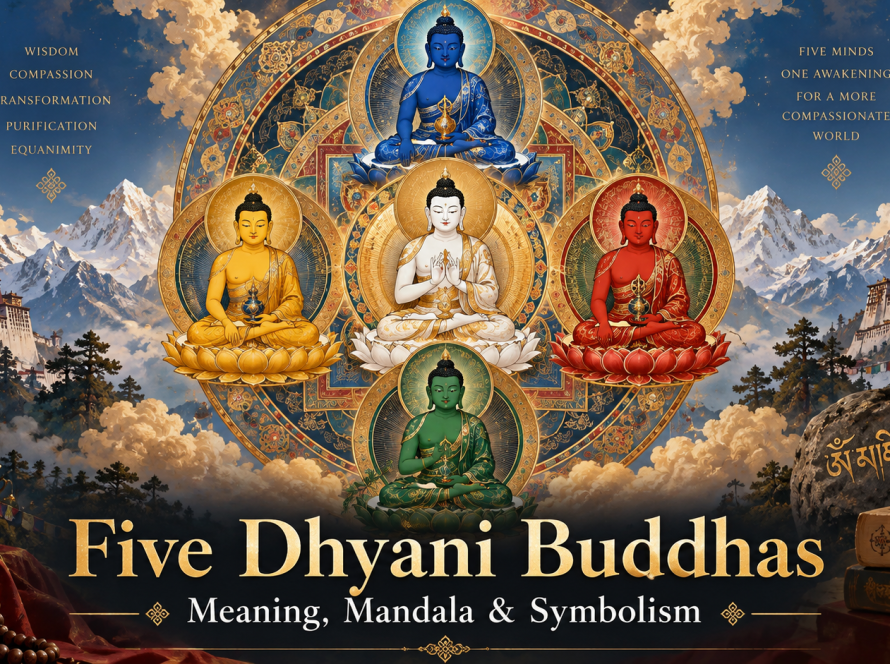
Across the Himalayan Buddhist world, this entire teaching is often distilled into visual form. Thangka paintings and sacred sculptures, including the striking imagery of the Nirvana Stupa, are not simply decorative art. They function as meditation supports, compressing centuries of philosophy into a single image a practitioner can sit with quietly. The elongated shape of a stupa, rising from a broad base toward a single point, mirrors the entire spiritual journey in physical form, moving from the grounded truths of ordinary existence toward the singular clarity of liberation.
For readers who want to go deeper into this symbolism, along with a fuller exploration of what nirvana means across the different schools of Buddhist thought, Enlightenment Thangka’s detailed guide to nirvana in Buddhism is a genuinely useful next stop, walking through the distinction between samsara and nirvana with real care and clarity.
A Freedom Worth Working Toward
Nirvana asks something far more demanding than most popular ideas of peace or relaxation ever do. It asks a person to look honestly at the fires of craving, aversion, and confusion running quietly underneath daily life, and to actually do the patient work of letting them burn out rather than constantly restocking their fuel. That is not a comfortable process, and Buddhist tradition has never pretended otherwise.
But the promise underneath that demand is extraordinary. A mind no longer gripped by grasping is a mind finally able to meet reality without flinching from it. That is what nirvana ultimately offers, not escape from the world, but the clearest, steadiest, and most compassionate way of actually living inside it.