At the heart of Kathmandu Durbar Square stands Kasthamandap, the legendary “Wooden Pavilion” believed to have given the city of Kathmandu its very name. Far more than a historic building, it embodies centuries of Newar woodcraft, a tradition still visible today in statues, carved window panels, and painted wooden artwork across the valley. This piece traces the history of this iconic structure and the enduring craftsmanship behind it.
Where Kathmandu Got Its Name
The name Kasthamandap comes from two Sanskrit words: “kastha,” meaning wood, and “mandap,” meaning pavilion. Historical records and copper plate inscriptions suggest it was built before the twelfth century, with some archaeological evidence pointing to origins as early as the Licchavi period. Originally constructed as a public rest house, it later became a shrine dedicated to the yogi Gorakhnath and a gathering place for community festivals and religious life.
What made Kasthamandap truly remarkable was its construction: a three-story structure built entirely from wood, without a single metal nail or trace of mortar. The entire building relied on interlocking wooden joinery, an engineering feat passed down through generations of skilled Newar artisans.
Window Panels: Newar Architecture’s Signature Art
Among the most striking features of Kathmandu’s woodcraft tradition are its intricately carved window panels, known as sajjha jhya, or “peacock windows.” Hand-carved from single pieces of wood, these panels showcase detailed latticework, floral motifs, geometric patterns, and scenes of deities. The famous Peacock Window of Bhaktapur is the best-known example, but Kasthamandap’s own window frames carry equally elaborate mythological and tantric designs.
Beyond their beauty, these panels served practical purposes, allowing light and ventilation while preserving privacy, embodying the Newar philosophy that devotion and function should be inseparable in design. After the pavilion’s destruction in 2015, artisans painstakingly rebuilt these windows using both salvaged original timber and new wood, carefully preserving the design language passed down over centuries.
Wooden Paintings: An Underappreciated Art Form
Often overlooked alongside carved reliefs, wooden paintings decorate the ceilings, beams, and interior panels of temples and pavilions throughout Kathmandu Durbar Square. Using natural pigments, typically red, gold, blue, and black, these paintings depict Hindu and Buddhist deities, tantric symbols, and mythological narratives directly onto wooden surfaces. Within structures like Kasthamandap, they served both decorative and devotional purposes, offering a visual language through which the Newar people communicated with the divine and preserved their cultural stories. Today, conservators work to revive this fading art form using traditional pigment-making methods.
Sacred Statues: Guardians in Wood
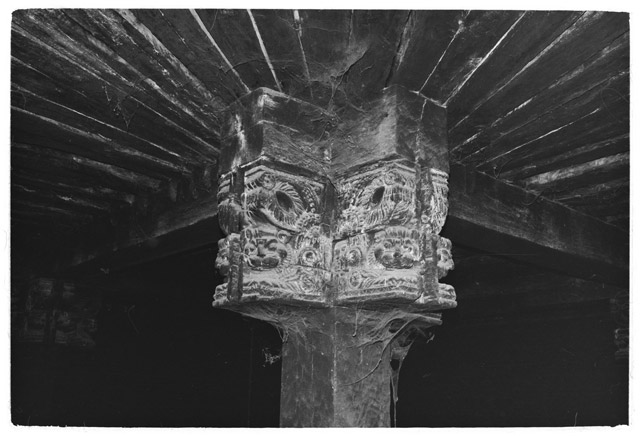
At the center of Kasthamandap stands a shrine to Gorakhnath, whose legend is intertwined with the pavilion’s origins. Local tradition holds that magical wood gathered by the yogi himself was used in its construction. Four massive “ship-mast” pillars, believed to be more than 900 years old, anchor the structure, each carved with protective deities. These wooden figures function not merely as ornamentation but as spiritual guardians and storytellers, each carving preserving a fragment of the valley’s mythology. Elsewhere across Kathmandu, similar carvings depicting tantric deities, Garuda, and celestial apsaras continue to be crafted in the workshops of Patan and Bhaktapur.
The Artisans Behind the Craft
This living tradition is carried forward by generations of Newar craftsmen, including those from traditional woodworking communities such as the Shilpakar caste. Skills in wood selection, joinery, carving patterns, and pigment preparation are passed master to apprentice, often within families, across centuries. Sal wood remains the material of choice for its strength and resistance to insects, and many artisans still rely on traditional tools chisels, hand drills, and mallets rather than modern machinery, preserving the authenticity of each finished piece.
Symbolism Woven Into Wood
Every carved element carries meaning. Garuda, the mythical bird and mount of Vishnu, appears frequently alongside nagas serpent deities linked to water and fertility and apsaras, celestial dancers. Lotus flowers, geometric mandalas, and tantric symbols recur throughout window panels and ceiling paintings, representing protection, prosperity, and rebirth. Fierce protective deities guard temple struts to ward off evil spirits, while street-facing window panels balance openness with privacy, a quiet reminder that in Newar art, beauty and utility are always intertwined.
Destruction and Revival
The devastating 2015 Gorkha earthquake reduced Kasthamandap to rubble, a loss that struck at the heart of Kathmandu’s cultural identity. In 2022, after years of collaborative effort between local communities, heritage experts, and international partners, the pavilion was carefully rebuilt using original materials wherever possible and, crucially, the same traditional Newar woodcarving methods that built it nearly a millennium ago.
Conclusion
Kasthamandap is, in many ways, a wood-carved chronicle of Kathmandu itself; its painted ceilings, carved windows, and sacred statues tell the story of a city shaped by devotion and resilience. From its mythic origins through its destruction and rebirth, the pavilion reflects the enduring strength of the Kathmandu Valley’s artistic heritage. The woodcarving tradition that built it remains alive today in the hands of Newar artisans across Patan and Bhaktapur, ensuring that this centuries-old craft continues to shape the city’s skyline and its soul for generations to come.